How Choice Brooklyn Increased Google Direction Requests by 47.5% With Local SEO
Connexup Team
Aug 7, 2026

After Choice Brooklyn opened its second location on Manhattan's Upper West Side, Connexup optimized its website and Google Business Profile. Measurable improvements appeared within about two weeks, core keyword visibility nearly doubled in the first month, and direction requests increased by 47.5%.
Choice Brooklyn was not a new restaurant brand. The family-owned café had been part of Brooklyn's Clinton Hill neighborhood since 2005, serving freshly baked pastries, specialty coffee, breakfast, and brunch.
In 2026, Choice Brooklyn opened its second location on Manhattan's Upper West Side. The space was ready, the team was in place, and the menu was finalized. Online, however, the new café was almost invisible to nearby diners.
When people searched for “brunch near me,” “Upper West Side café,” or “breakfast near Broadway,” Choice Brooklyn rarely appeared in the results. Even when diners found the location, incomplete hours, a missing menu, or conflicting business details could be enough to send them elsewhere.
That was the challenge Choice Brooklyn brought to Connexup: the brand had years of operating history, but Google still could not clearly understand who the new location was, where it was, or what it offered.
Even an Established Brand May Need to Start From Zero
Many restaurant owners assume that opening a second location simply means adding a new address to the website and Google Maps. Local search does not work that way.
Nearby diners usually search by location, dining occasion, or what they want to eat—not by brand name. They may search for “breakfast near me,” “brunch on the Upper West Side,” or “café near Broadway.”
Google uses location details, website content, business information, menus, reviews, and other online signals to determine whether a restaurant is relevant to those searches. If a new location's information is incomplete or inconsistent across channels, it may need to build its own local SEO foundation, even when the original location has been operating successfully for years.
For Choice Brooklyn, the problem was not the absence of a website or Google Business Profile. The problem was that the two did not present one clear, consistent picture of the new location.
Why Was the New Location “Invisible” on Google?
After taking on the Upper West Side location, Connexup first reviewed the website, Google Business Profile, and the customer journey from search to visit.
Rather than immediately recommending a website redesign, the team identified the specific issues preventing Google from understanding the location. The diagnosis revealed three main problems.
1. The New Location Did Not Have a Consistent Online Identity
The business name and phone number on the website did not fully match the information on the Google Business Profile. Different website pages also referred to the brand as both “Choice Market” and “Choice Brooklyn.”
When business names, phone numbers, and operating hours do not align, Google may struggle to confirm that the information belongs to the same location. Diners may also be unsure which version is accurate.
2. Google Could Not Tell Which Searches the Restaurant Was Relevant To
The website did not clearly state that the new café was located on Manhattan's Upper West Side. It also lacked clear references to its main categories, including café, breakfast, and brunch.
The Google Business Profile was also missing complete menu information, business attributes, photos, and operating hours.
With limited information available, Google had little basis for deciding whether Choice Brooklyn should appear for searches such as “brunch near me” or “Upper West Side café.”
3. Diners Could Not Easily Take the Next Step
Some website pages lacked clear titles and descriptions. There were also broken ordering links and inconsistent operating hours. Customer reviews on the Google Business Profile had gone unanswered.
Even when diners found the restaurant, unclear menu information, hours, or ordering options could prevent them from viewing the menu, getting directions, or placing an order.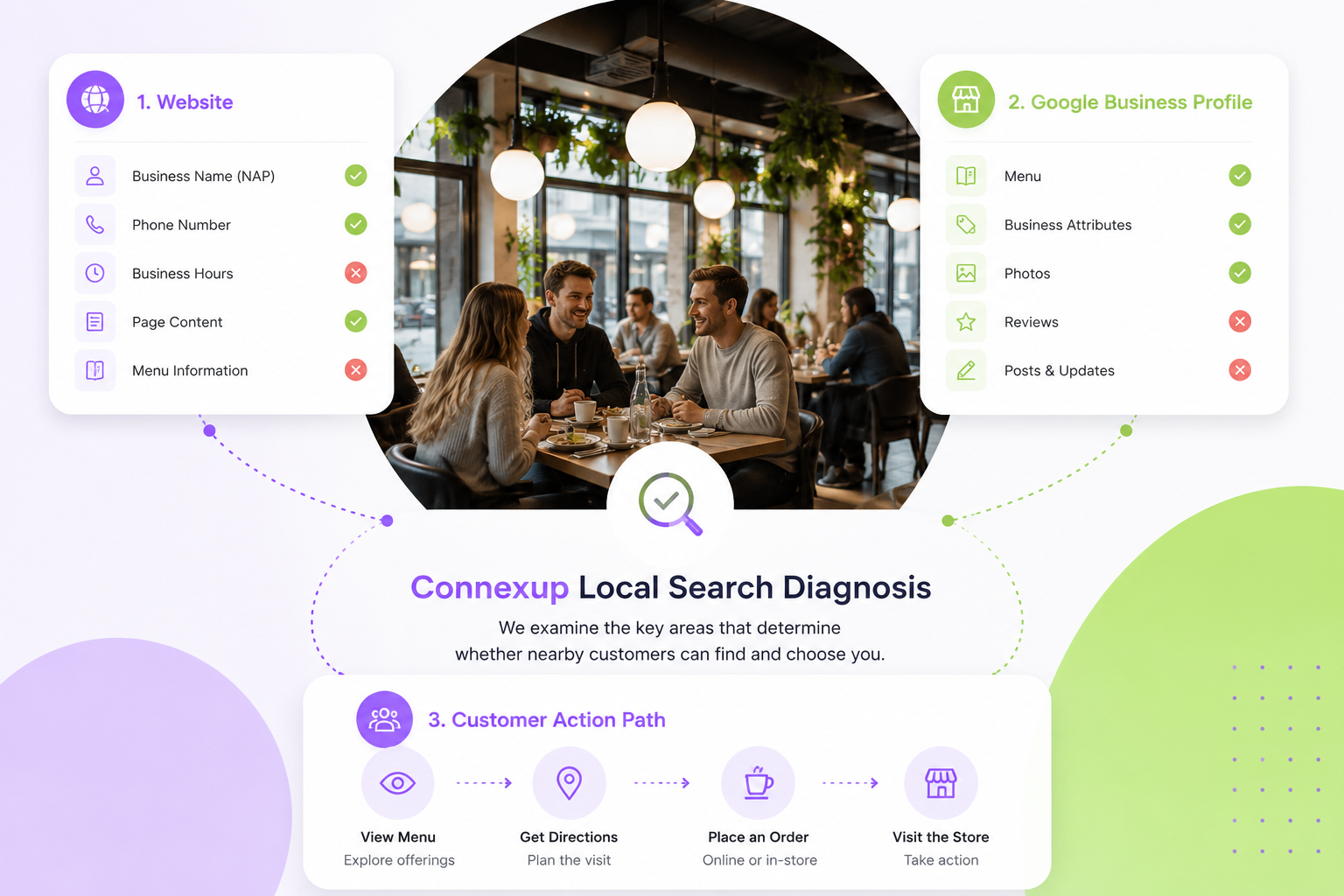
Why Review Both the Google Business Profile and the Website?
A Google Business Profile is a major entry point for restaurant discovery, but it cannot provide every local search signal on its own.
For Google, the Business Profile and the restaurant's website are not separate, unrelated channels. They should support and verify each other, together explaining the location's identity and what it offers.
Local SEO is therefore not just about maintaining a Google listing. The website, business information, menu, reviews, and ordering journey need to form one clear system that customers and search engines can understand.
Within that system, the website plays three important roles.
1. It Gives Google More Complete Location Information
A Google Business Profile can show an address, operating hours, rating, and photos. The website can provide more detail about the neighborhood, core menu categories, signature items, and service options.
For multi-location brands, the website also helps Google distinguish between locations and connect each one with the correct address, phone number, hours, and ordering page.
2. It Expands the Searches the Restaurant Can Appear In
Diners do not always search by brand name. They may search by neighborhood, daypart, menu item, or service.
A Google Business Profile contains relatively fixed information. The website can provide more context through location pages, menu pages, event pages, and brand content. The clearer this information is, the easier it becomes for Google to understand which searches the restaurant is relevant to.
3. It Supports the Diner's Next Action
After finding a restaurant on Google, diners often want to check the menu, prices, atmosphere, operating hours, or ordering options.
The Google Business Profile answers, “Can I find this restaurant?” The website then needs to answer, “Is it right for me?” and “What should I do next?”
If the menu does not load, the hours do not match, or an ordering link is broken, search visibility may still fail to produce a visit or order.
A restaurant website therefore does more than present the brand. It helps Google understand the business and supports the customer journey from discovery to purchase.
How Connexup Improved Choice Brooklyn's Local Search Performance Without Rebuilding the Website
Choice Brooklyn's owner wanted to preserve the existing website design and structure. After completing its review, Connexup agreed that the visual design was not the main issue. The real problem was that the website and Google Business Profile did not present the location's information clearly or consistently.
This is what makes the case especially relevant to restaurant owners: a website is essential to local search, but improving its search value does not always require an expensive, disruptive rebuild.
Connexup worked within the existing website and focused on three areas.
1. Completing and Maintaining the Google Business Profile
Connexup added business attributes for dine-in, takeout, delivery, Wi-Fi, and other services. The team also uploaded a complete, clearly categorized menu with photos and descriptions.
Choice Brooklyn began publishing regular Google updates, adding recent photos and videos, and setting accurate holiday hours so diners would not see outdated information.
Review management also became part of the ongoing process. With AI-assisted responses, every new review received a relevant reply within 24 hours. The location went from replying to none of its reviews to responding to every one.
2. Correcting Website Information and Page Content
Connexup standardized the brand name as “Choice Brooklyn” and corrected the phone number so the website matched the Google Business Profile.
The team updated page titles and descriptions across the homepage, menu, about, events, and shop pages, naturally adding the location and restaurant categories diners were actually searching for.
Connexup also fixed missing or duplicate headings, broken ordering links, and inconsistent operating hours across the site.
These changes did not alter the website's visual design. They simply made it easier for Google and diners to understand where the restaurant was located, what it offered, and how to view the menu, get directions, or place an order.
3. Adding Technical Information Google Could Read More Easily
Connexup added restaurant structured data to the website, marking the business name, address, operating hours, menu, and other key details in a format Google could interpret more clearly.
Structured data does not change what diners see on the page. It helps Google identify the location more accurately, which is especially important for a new restaurant with little existing search history.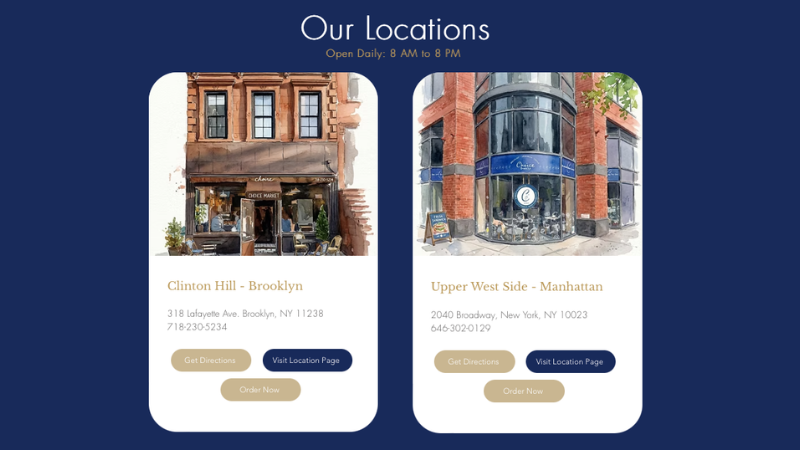
From Search Visibility to Real Visits: What Changed?
The value of local SEO should not be measured only by keyword rankings. The more important question is what diners do after they find the restaurant.
After Connexup began the work, measurable search movement appeared for Choice Brooklyn's Upper West Side location within about two weeks. In the first month, search visibility, menu engagement, and direction requests all improved.
Key metric | Change after optimization |
|---|---|
Average visibility across core keywords | Nearly doubled in the first month |
Direction requests | Increased 47.5% |
Google menu views | Increased 29% |
Overall Google Business Profile visibility | Increased 27.7% |
Time to first measurable movement | About two weeks |
Categories that previously had no search visibility, including “bakery” and “catering,” began appearing in search results.
Some of the strongest gains came from searches such as “breakfast Broadway NYC” and “brunch near me.” These searches typically come from diners actively comparing nearby options and showing clear intent to visit.
The 47.5% increase in direction requests showed that diners were not simply seeing Choice Brooklyn online—they were checking the route and preparing to go. The 29% increase in menu views showed that more people were moving from discovery to active consideration.
At the same time, the location went from replying to no reviews to responding to every review, while maintaining its 4.9-star rating.
These results show why online visibility is more than an abstract marketing metric. Menu views, category searches, and direction requests indicate that diners are moving from “I found this place” to “I may visit.”
Five Checks for Restaurants Opening New Locations
Choice Brooklyn's experience applies beyond cafés. Restaurant brands opening a second location, entering a new neighborhood, or expanding into a new city can focus on five key checks.
1. Is the Online Presence Ready When the Location Opens?
The Google Business Profile, website location page, menu, operating hours, and directions should go live around the time the restaurant opens. Otherwise, interested diners may be lost simply because they cannot find accurate information.
2. Does Each Location Have a Clear Online Identity?
Every location should have its own correct name, address, phone number, operating hours, and ordering link. That information should remain consistent across the website, Google Business Profile, and other platforms.
3. Does the Website Clearly Explain Where the Restaurant Is and What It Serves?
Beyond the brand story, the website should clearly state the neighborhood, restaurant type, main menu categories, and service options. This helps Google connect the location with real local searches.
4. Is the Google Business Profile Actively Maintained?
Menus, photos, operating hours, holiday schedules, and customer reviews should be updated regularly. A Google Business Profile is not a one-time setup. It is one of the main ways diners decide whether a restaurant is open, current, and worth visiting.
5. Are You Tracking What Diners Do?
Rankings matter, but restaurants should also monitor menu views, direction requests, website clicks, phone calls, and online orders.
Effective local SEO does more than help a restaurant appear in search results. It helps diners move smoothly from discovery to menu viewing, directions, and ordering.
Getting Found Is the First Step in Growing a New Location
Choice Brooklyn's progress did not come from a major website redesign or from simply adding a few keywords. Connexup first identified the specific issues preventing the new location from being discovered, then reconnected the website, Google Business Profile, menu, reviews, and customer journey.
As a result, Google could understand the location more clearly, and nearby diners could move more easily from search to menu viewing, directions, and an in-person visit. Core keyword visibility nearly doubled in the first month, menu views increased by 29%, and direction requests rose by 47.5%.
For multi-location restaurant brands, the challenge is often not knowing that hours should be updated or reviews should be answered. It is identifying which issues are limiting a specific location's search performance—and which changes are most likely to influence customer action.
If you are preparing to open a new location, or your restaurant remains difficult for nearby diners to find on Google, Connexup can provide a free local SEO audit. We will review your website, Google Business Profile, location information, and customer search journey to help you understand what may be holding the location back before deciding what actually needs to be improved.